Why Soul Insole Is Getting So Much Attention for Foot Pain, Alignment, and All-Day Comfort
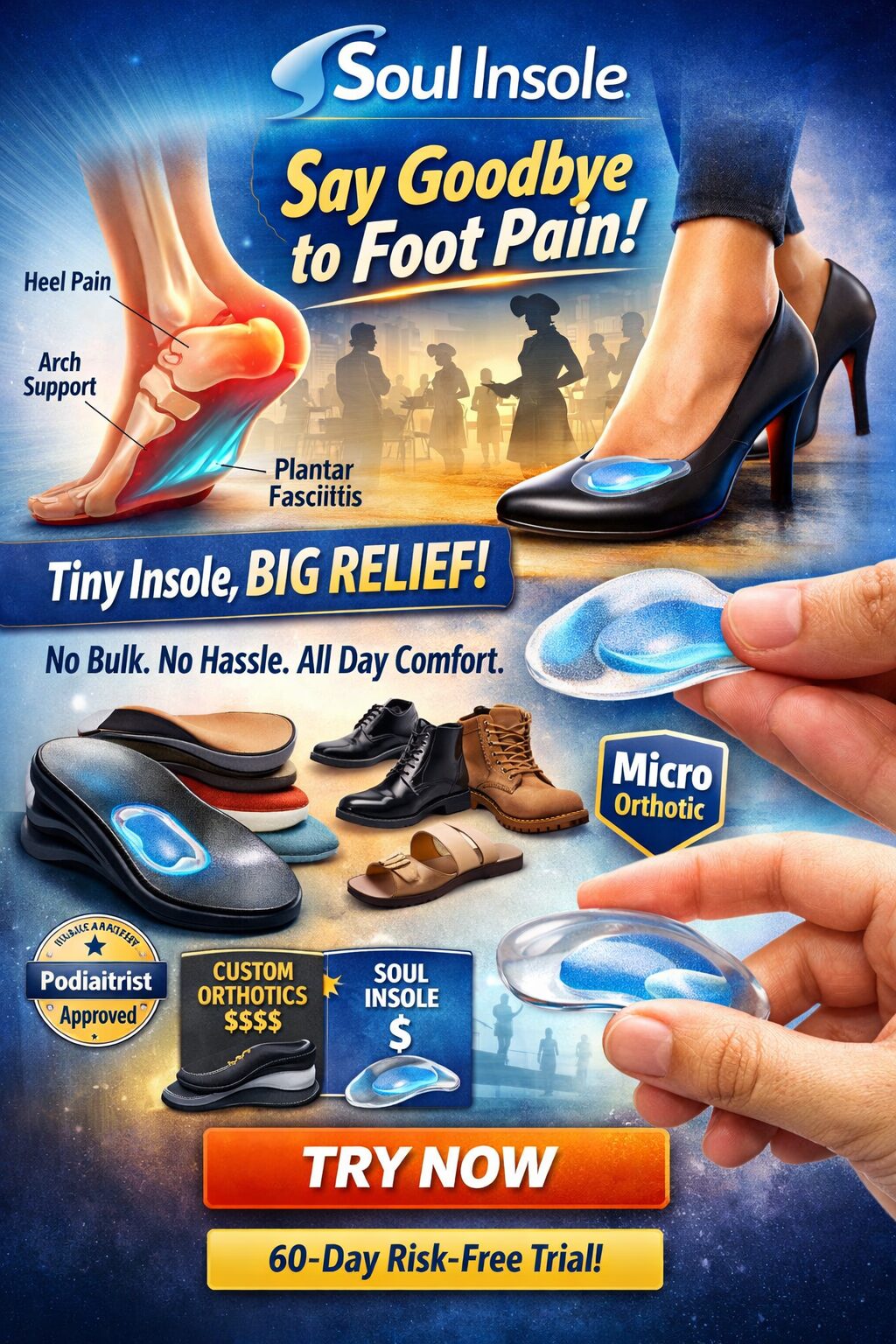
Soul Insole has been popping up everywhere lately, and Soul Insole is getting attention for a simple reason: people want relief that doesn’t eat up shoe space, wreck fit, or cost custom-orthotic money. If you’ve been hunting for a real answer to heel pain, arch fatigue, plantar fasciitis, or that vague “my whole body feels off” discomfort after standing all day, this product lands in a very interesting lane.
Most insoles fall into one of two buckets. They’re either cheap, soft, disposable-feeling inserts that flatten fast, or they’re bulky orthotics that make your shoes feel like cramped little prison cells. Soul Insole’s pitch is different. The brand positions it as a micro-orthotic—small enough to fit into more shoe types, but structured enough to offer meaningful support and pressure redistribution. That’s the big idea anyway, and it’s what makes this review worth reading all the way through.
And let’s be real: this category is huge because the problem is huge. The American Podiatric Medical Association’s research found that 77% of U.S. adults have experienced foot problems, and 51% say foot pain has restricted activities. On top of that, plantar fasciitis alone affects about 10% of the general population, accounts for roughly 1 million patient visits a year, and is especially common among working adults between 25 and 65. This isn’t niche. This is mass-market pain with a very literal ground-floor cause.
So the real question is not, “Does Soul Insole sound clever?” The real question is: Does it solve the annoying tradeoff between support and wearability? That’s where things get interesting.
What Is Soul Insole, exactly?
Soul Insole is a foot-support brand founded by Laina Gossman, whose background includes kinesiology, biomechanics, and orthotic design. According to the company, the product was born out of frustration with traditional orthotics that were effective for some people but too expensive, too rigid, too bulky, or too hard to use across multiple shoe types. The company says it has now helped over 1 million feet walk more comfortably.
The flagship concept behind Soul Insole is that it’s small and flexible, not a full-length slab that swallows the interior of your shoe. The brand says the support is designed to relieve pressure from the heel and forefoot, improve balance and alignment, and fit into sneakers, heels, dress shoes, boots, and more without changing fit the way conventional insoles often do.
That last part matters more than most people think. A lot of folks don’t ditch insoles because support “doesn’t work.” They ditch them because the things are awkward. They crowd the toe box. They change how the shoe feels. They slip. They make already snug shoes unusable. Soul Insole is clearly trying to win on that pain point first.
The real deal of Soul Insole review, complaints, and official website queries
When a product starts getting traction, search behavior of window shoppers gets hilariously predictable. People type:
- Soul Insole review
- Soul Insole complaints
- Is Soul Insole legit
- Soul Insole official website
- Soul Insole for plantar fasciitis
- Soul Insole vs custom orthotics
- Where to buy Soul Insole
That tells you what buyers actually care about: legitimacy, comfort, pain relief, fit, durability, and whether this is just another overcooked advertorial with big promises and small payoff.
On the legitimacy side, there are a few concrete signals. The brand has an official website, product pages, customer-review pages, an Amazon storefront presence, and a founder story that appears consistently across brand materials. The advertorial pages also repeat the same core claims: a micro-sized orthotic design, use across many shoe types, and a 60-day risk-free trial through the offer page.
That doesn’t prove the product will work for every foot on Earth—nothing does—but it does move it out of sketchy one-page-drop-ship territory. That’s a decent start.
What makes Soul Insole different from regular insoles?
The simplest answer? Form factor plus positioning.
Most budget insoles aim to cushion the entire footbed. Soul Insole focuses on targeted structural support in a much smaller profile. That means it’s not trying to be a plush mattress for your shoe. It’s trying to alter support and pressure distribution without taking over the whole shoe interior. According to the brand and associated advertorial content, the design uses memory gel and a patented orthotic design intended to guide the foot into better alignment during wear.
That’s the theory, and frankly, it fits a real market gap.
Because here’s the deal: ma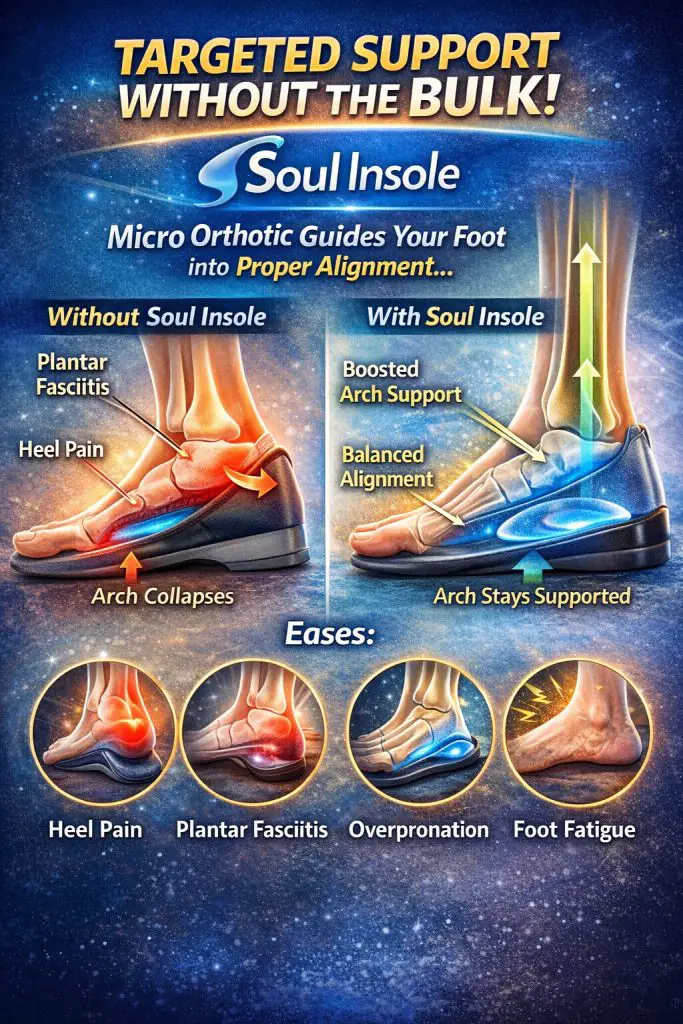 ny people don’t need—or won’t tolerate—massive rigid devices. They want something they can actually wear in heels, flats, boots, narrow shoes, casual sneakers, or office shoes. Soul Insole’s biggest value proposition is not just “support.” It’s portable support you might realistically keep using. Compliance is the unsexy hero of pain relief. The perfect insert you never wear is, medically speaking, decorative nonsense.
Soul Insole for plantar fasciitis, flat feet, high arches, and standing all day
This is where search intent gets practical. People aren’t usually looking for an insole because they adore biomechanics. They’re looking because their feet are rude to them every morning.
1. Plantar fasciitis
Plantar fasciitis is the most common cause of heel pain in outpatient settings. It affects around 10% of the general population, contributes to 11% to 15% of foot symptoms requiring professional care, and can hit runners at rates as high as 22% in some literature. Supportive insoles can help by offloading pressure and improving mechanics, though the best solution varies by severity and foot type.
Soul Insole is marketed heavily toward plantar fasciitis users, and that makes sense. If your heel hurts but you also can’t deal with thick full-length inserts in every pair of shoes, a smaller orthotic-style insert is appealing.
2. Flat feet and overpronation
The brand and product listings specifically mention overpronation and flat feet. For people whose arches collapse inward, targeted arch support can help reduce the chain reaction that travels up through the ankles, knees, hips, and low back.
3. High arches
High arches often need pressure redistribution because body weight can be concentrated on smaller contact zones. Soul Insole says its design works for both high arches and flat feet alike, which is ambitious but not impossible when the support is targeted rather than one-size-fits-none foam mush.
4. People who stand all day
Retail workers, teachers, warehouse teams, nurses, hospitality staff, trade workers, salon pros—basically, the “I hit 10,000 steps before lunch and my feet are filing HR complaints” crowd—are prime candidates for a product like this. The benefit is less about athletic performance and more about fatigue management.
Real use cases: who is Soul Insole actually good for?
Let me make this less abstract.
The office professional in dress shoes
A bulky insole often doesn’t work in narrow dress shoes. Soul Insole’s thin, compact profile is one of its clearest advantages here. If you need mild-to-moderate support in formal shoes without changing fit too much, this is exactly the scenario where a micro-orthotic makes more sense than a full insert.
The woman who still wants to wear heels
The APMA’s survey noted that high heels are the number one culprit of foot pain, and the average woman who owns heels owns 9 pairs. Soul Insole explicitly markets itself for heels and other fashion-first shoes, which is a major differentiator because most support products pretend stylish footwear doesn’t exist.
The walker or casual runner
If you walk daily, travel a lot, or jog recreationally, you probably want support without overengineering. Soul Insole may fit that sweet spot better than rigid custom devices, especially if you move shoes often.
The person bouncing between multiple shoe types
This is low-key one of the strongest cases. If you wear sneakers on weekends, boots to work, and sandals or flats in between, a smaller insole system becomes more convenient than owning a custom insert for every shoe category.
The budget-conscious buyer
Custom orthotics can cost $300 to $800, and some systems can run $1,000 or more. Drugstore inserts may cost $10 to $20, but they’re usually generic and minimally customizable. Soul Insole sits in the middle of a very attractive value conversation: more specialized than bargain-bin foam, less financially violent than custom orthotics.
Soul Insole vs custom orthotics
This is the comparison everyone should read before buying.
Custom orthotics are prescribed and tailored, often after a professional assessment or foot scan. For serious structural issues, severe pain, diabetic complications, or gait problems that need medical oversight, custom orthotics still have a strong case. They’re custom for a reason. But they’re expensive, not always covered by insurance, and often less versatile across different shoe types.
Soul Insole is not pretending to be a one-to-one replacement for every medical orthotic scenario. Its appeal is different:
- lower upfront cost than custom orthotics
- easier use across multiple shoe types
- less bulk
- easier entry point for people who aren’t ready to commit hundreds of dollars
In other words, custom orthotics are the high-precision option; Soul Insole is the high-convenience option. If your issue is moderate pain, fatigue, arch strain, or shoe incompatibility, Soul Insole could be the more rational first buy. If your issue is severe, persistent, or medically complicated, it’s smarter to see a professional.
That’s not me hedging. That’s just adult-level buying advice.
Soul Insole vs cheap drugstore insoles
Cheap insoles usually win on price and lose on staying power. They can feel good for a hot minute because softness is instantly pleasant. But soft is not always supportive. In fact, podiatry-guided buying advice often warns that overly soft inserts may lack the structure needed for conditions like plantar fasciitis, where arch stability and heel control matter.
Soul Insole tries to occupy the middle ground: not a rigid medical brick, not a squishy nothing-burger either.
That’s why it’s attracting buyers who are tired of the classic cycle:
buy cheap insert → feel temporary relief → flatten it out → buy another → repeat until annoyed.
What do reviewers and experts seem to like?
The brand’s official site highlights endorsements and testimonials from practitioners and customers. One expert endorsement featured on the site says the insoles offer “exceptional comfort” and can be customized for where support is needed. Another practitioner, Dr. Emily Splichal, is quoted recommending them to clients and describing arch-lifting support for overpronation and plantar fasciitis-related issues. The brand also says it has accumulated substantial customer feedback over time, including hundreds of five-star reviews in older posts, while Trustpilot search results show hundreds of reviews as well.
Now, I wouldn’t build a buying decision on hype alone. But these signals do suggest that Soul Insole has had enough real-world adoption to generate meaningful user response, not just launch-week noise.
Potential downsides and honest complaints to think about
No legit review should act like a product descended from heaven wearing orthopedic angel wings.
Here are the realistic drawbacks:
1. It may not be enough for severe cases
If you have severe biomechanical issues, advanced deformity, serious diabetic foot concerns, or persistent pain that’s getting worse, a compact insole may be too light-touch.
2. Adjustment period is possible
Any support that changes alignment can feel odd at first. Even good insoles can need a break-in period. That’s normal, not scandalous.
3. Smaller profile means targeted support, not full-foot cushioning
If what you want is a plush, cloud-like, full-length cushioned insert, Soul Insole may not scratch that itch. This isn’t really its lane.
4. Marketing can feel a bit dramatic
Some of the advertorial copy leans hard into that classic direct-response style. You know the vibe—“everything you thought you knew is wrong” energy. That doesn’t automatically make the product bad, but it does mean you should separate the copywriting fireworks from the actual utility.
Is Soul Insole worth trying?
For a lot of buyers, yes.
I’d say Soul Insole is worth a try if you’re in one of these camps:
- you need arch or heel support without making your shoes tighter
- you rotate across different shoe styles
- you’re dealing with mild-to-moderate plantar fasciitis or foot fatigue
- you want something more specialized than cheap inserts
- you do not want to jump straight to a $300-to-$800 orthotic bill
It is especially compelling for people who say some version of:
“I know I need support, but I refuse to wear clownishly bulky insoles.”
Honestly? Fair.
Where to buy Soul Insole
If you want to buy Soul Insole, the safest move is the obvious one: buy from the official website.
The brand’s special offer page explicitly says purchases there are direct from Soul Insole, the inventors of the product, and recommends buying there instead of third-party retailers. The advertorial offer page also mentions a 60-day risk-free trial, which is a meaningful buying incentive if you’re unsure how your feet will respond. There are third-party listings on places like Amazon and other retail platforms, but the official site is the cleanest path if you want the brand’s current offer, direct support, and the most straightforward authenticity signal.
So if you’re searching where to buy Soul Insole, the best answer is: start with the official Soul Insole website.
Quick FAQ about Soul Insole
Is Soul Insole legit?
It appears to be a real, established brand with an official site, founder history, multiple product listings, customer-review pages, and third-party marketplace presence.
Is Soul Insole good for plantar fasciitis?
It is marketed for plantar fasciitis and related heel/arch pain, and its design concept aligns with the general need for support and pressure redistribution. That said, very severe cases may still need clinician-guided care.
Can Soul Insole fit heels and dress shoes?
That’s one of its strongest selling points. The brand emphasizes compatibility with heels, dress shoes, boots, sandals, and sneakers.
Is Soul Insole better than custom orthotics?
For convenience and versatility, it may be. For severe or medically complex conditions, custom orthotics may still be the better tool.
Does Soul Insole have a money-back guarantee?
The advertorial offer page states there is a 60-day risk-free trial.
Final verdict
Soul Insole isn’t interesting because it claims to do everything. It’s interesting because it solves a very specific and very common problem: people want support they’ll actually wear. The product’s compact design, cross-shoe versatility, founder credibility, and middle-ground value proposition make it more compelling than the average insole pitch. Add in the fact that foot pain is wildly common, activity-limiting, and expensive to manage when you go fully custom, and the appeal starts making a lot of sense.
Would I call it a miracle? No. That word gets abused harder than airport flip-flops.
Would I call it a smart try-before-you-go-full-custom option for many people with foot fatigue, arch strain, heel discomfort, overpronation, or shoe-fit frustration? Yeah, absolutely.
And if you’ve been doom-scrolling through Soul Insole searches trying to decide whether Soul Insole is hype or a genuinely practical buy, here’s the clean answer: it looks like a credible, wearable option with a real niche—and for the right feet, that niche is a big one